Canalblog Tous les blogs Top blogs Associations & ONG
Suivre ce blog Administration + Créer mon blog
MENU

Team One

Publicité
Team One
Publicité
Publicité
8 octobre 2007

Chapter Three: Tour of Kokkola and trip to Alavetli – or Finnish Sightseeing… [2/2]

Photo166

above: our archaeologist explaining us how the tar was made


Helena

thought that the archaeologist was fed up with us from the start and didn’t really know what he had to tell us. He told us he didn’t want to ‘bullshit’ us by telling us something wrong and he couldn’t really explain everything as a ‘shit load’ of things could have happened. This vocabulary was quite surprising for a university trip. However, it was interesting to see all these, to know that things we wouldn’t expect to be prehistoric are all around us.

We played Kubb, a prehistoric game, actually still played all over

Sweden

(perhaps they feel prehistoric inside themselves, you never know).


IMG_7684


above: people carefully listening to the Kubb-rules


In this game, you have one team on each of the two sides. Every team stands behind his six soldiers, and has to try to knock down the opposite soldiers with wooden sticks. This was actually very nice, we were not all with our own teams (but we were together and we won! team 1 rules!).

IMG_7696

above: team 1 (Helena- Liu – Cyril )– we won together with some other people

The archaeologist said we had won a bottle of Koskenkorva and that we had to ask Esko for it.

We had a last look at cairns(where people used to be buried) on the way back. To be honest, it was quite a pity because – yes, you can see the stones and other mortuary things – but, everything is just left like that in a poor state, with moss growing everywhere… You can’t really see what it was once. Just holes with stones standing.

kuva

above: our archaeologist showing us some ancient remains


This trip was a nice one, it was interesting to see some actual Finland in the morning and then some prehistoric Finland the afternoon. We could see that people have always taken profit of their surroundings to live: in the past to make their homes (stones, moss, etc), and nowadays, to be competitive (port, deep waters, etc).

Publicité
8 octobre 2007

Chapter Three: Tour of Kokkola and trip to Alavetli – or Finnish Sightseeing… [1/2]

On Thursday 27th of September, we had another trip: first a tour of Kokkola by bus, then a trip to the site of Alavetli.


We left early in the morning -perhaps too early for some people- however we got going anyway!
We drove through the old parts of Kokkola, Kirkonmäki (: Church Hill) a place which used to be an island when water was deeper inlands. We could see typical old houses and a very beautiful old wooden white church where many couples like to get married.


red_house

above: picture of a traditional wooden house in Kirkonmäaki

Our guide Anit Löf told us about the ‘Omakotitalo’s – people like to have their own homes rather than living in a row house. It’s the same in France and Switzerland, even though you don’t always have the choice as housing is very expensive. In China, people actually mainly have to live in row houses – the population being so numerous.

Surely, if one had the choice, one would go to live in one of those sweet little houses among the trees.
Unfortunately, we couldn’t stop to take some pictures (it’s not very nice to take pictures from the bus – with the windows).

 We continued our visit towards the port of Kokkola, the all weather terminal (ATW) on Yxpila Harbour.

 IMG_7647

above: taken at the port entrance


A person from the Port came to explain us about the facilities, we couldn’t really realise how special it was, as we are not so familiar with ports – unfortunately. However, it was enormous; very big boats can enter the ‘shelter’ and be loaded and unloaded at anytime of the year as the water in the boathouse doesn’t freeze. The shelter is 122 meters long,25 meters wide and 23.5 meters high. There are two ports there: a general port and a deep port.

IMG_7650

above: Helena taking notes during the port presentation


The port is very good for Kokkola and its surroundings, as there are workstations for many people. Furthermore, the port of Kokkola has one of the only AWT’s in Europe. Therefore it’s a major asset for the companies and the economy in general. It is a specific kind of port and the fact it is rare in Europe makes the Port very valuable.

IMG_7645

above: picture taken in the shelter


After the port, we drove through the industrial zone, many chemical companies operate near (and thanks) to the ATW, that offers a variety of cargo service possibilities. Furthermore, there are very good connections with Europe and Russia, thanks to the railroad and motorways. There are also a lot of boatbuilding companies in the port area of Kokkola.

Kokkola is well situated; there is no doubt about it. It’s all very positive for the town. Employment must be good and it could even be interesting for us - foreign students - if we have to find a work placement. The trade at the port is quite international, so they would need people speaking other languages! We should think about it…


After a small stop at the COU for coffee break, we went off to Alaveteli.
The road was a bit winding and it’s not the most comfortable one! However, we saw quite nice landscapes again, trees, fields…and more trees… we are in  Finland at least!

Nearly 20 minutes later, we were in Seljes, near a lake… Typical

Finland again!


IMG_7654


bove : picture of Seljes lake


It was cloudy and grey, but still very beautiful. We had some free time to walk around, look at the lake, see the small fish, walk up and down the ‘laituri’ …
It was actually a camping site, there were many little huts between the trees, it must be a fantastic place to stay – probably only in summer time!

IMG_7663


above : picture of the camping site


We had a nice lunch, salmon soup (which seems to be the traditional trip meal – nothing wrong about it, it was great) before getting on the move.


IMG_7655

above : the main building where we had lunch


We left with Lauri - from the museum of Kokkola - and an archaeologist who didn’t really seem to be at his ease with us.

They told us about what life was like in Finland many hundred years ago (information we had also received during the course Finnish Society and Culture). We got a comprehensive picture of the prehistory there.

People built huts in the moss with stones and wood, partially dug in the ground. They seemed to be quite clean. However this isn’t a history course, so we shouldn’t really explain the lives of our ancestors. Even though, the traces of prehistoric men are clearly visible as ancient remains on the ridges.

6 octobre 2007

Chapter Two: Watching a movie.. [3/3]


Are there clashes and tensions of values?

Xavier, Isabelle and their friends don’t understand a word when the class is in Catalan. Isabelle is tasked with telling the teacher for teaching the class in Castilian. However, he doesn’t accept because most of the students are Catalan. When Isabelle talks about fifteen Erasmus students who don’t know Catalan, the teacher talks about Catalan which is official language and he says if they wanted to speak Spanish, they could go to Madrid or South America.

When Wendy’s brother William comes to visit his sister, he starts making jokes about the countries, although he hasn’t been there in the first place. He starts to make people angry with telling stupid clichés about countries.

Clashes and tensions of people?

Xavier’s father wants him to do a job ,but he doesn’t really want. His father helps him to get a job which has something to do with the Spanish economy. So if Xavier studies Spanish economics, his father will find him a job. However, in order to find the job, Xavier has to speak Spanish well and has to know the Spanish market. However, Xavier doesn’t speak Spanish very well. He decides to go to Spain for a year although he doesn’t know what he wants to do really and he isn’t sure at first. When he thinks again he decides to go because of getting out of his situation.

Xavier decides to go to Spain in order to find himself. Also, he is distressed because of the works for joining Erasmus program. He thinks about the world as such a mess because everything is complicated and out of whack and he thinks the fields with cows and chickens which were in the past and according to Xavier everything was much simplier in the past. He compares today and past. Therefore, he has a lot of clashes in his brain and he wants to find himself.

Xavier’s mother makes Xavier angry about going to Spain because she asks him if it is good idea. Because she thinks that this is the idea of Xavier’s father and Xavier doesn’t want to go, but Xavier gets angry because - according to Xavier - it is his own idea.

When Xavier goes to interview to get a room in a shared flat, Tobias asks him some questions and one of them is about the plan of his life in the next five years. This question caused clashes among the flatmates. For example, Wendy doesn’t know what her life will look like in five years and according to Wendy this question is rubbish and ridiculous. However, Tobias defends his questions.
Although William meets with two Spanish people, because of his comments about Spanish people, Isabelle gets angry with him. When Tobias studies to his exams, William comes his room and starts disturb him with speaking about Adolf Hitler and something unnecessary.After these situations Wendy gets angry with his brother and warns him because of his behaviours.

Martine breaks up with Xavier after he has been in Barcelona for several months already. Then Xavier goes to

France to talk to Martine. They start to discuss. According to Martine, Xavier never loved her, he is incapable of loving someone and always cares about his studies, career and the job at the ministry. Therefore, they broke up with some clashes. When he returns to Spain, he goes to the airport with his mother. She asks him why he comes back only for one day and if he is not happy with her. So he gets really angry, because he doesn’t want to talk about it.

After Anna – the former girlfriend of Lars - comes and Lars learns that he has a baby, Soledad gets very angry with Lars because of his cool attitude. According to Soledad, Lars has to do something like scream, cry, smash something, he mustn’t just sit like nothing happend because he is a father and has a baby.

Wendy and Xavier debate because of Wendy’s American boyfriend. According to Xavier, he is a stupid boy. Wendy accepts that he is stupid ,but she’s attracted by him allthesame. When they meet with the American boy, he playes the guitar, they sing and Wendy loves that. However, that is very ridiculous for Xavier because the name of the song is “No woman, no cry”. When Xavier asks about her other boyfriend, Wendy gets angry very much.

Jean-Michel gets to know about Xavier’s relationship with Anne-Sophie and that they have an affair together. So he talks to Xavier and wants to stop him seeing his wife. Jean-Michel gets angry with Xavier.
At the end , when Xavier starts his new job, people seem to be completely opposite than from what he wants. People seem to be really straight, boring and do the same things everyday. He is confused, runs away and starts a career as a writer...

What is the message of the film from the perspective of cultural and intercultural learning?

The group decided, that we don’t give one answer to this question, but everyone is giving his own answer, as everyone sees those things a bit differently.


[Cyril]

“The Spanish Apartment” is a great film. I saw that one about 7 years ago in cinema already, and also the sequel to it. The film shows in a great way, how an exchange semester can be. I’m pretty much feeling in a similar way as Xavier. When I arrived here, I was sad and a bit homesick, but just after a few weeks I met some great people, with which I hope to stay in contact even after this semester! The film indicates, how easy it can be for people from different cultures and countries to live together, as long as they adapt to the others. “The Spanish Apartment” also shows that you can learn much from people from other countries. Xavier finished his exchange year and he hasn’t just made new friends, but got to know himself. He found out, who he is. That is one of the most important things in life. That might happen to some of the exchange students here in Kokkola as well…

[Helena]

ERASMUS is like a password, nearly a keyword that means a lot. In the film, an Erasmus is a foreign student but it usually also means that it is an open minded and partying foreign student.

This film is about finding your way, finding out who you are. It tells the story of a lost guy who is not himself, people have put expectations upon him (his father wanted him to study economics; his mother was contradicting him all the time). He had lost his dreams of sight, his wishes and desires. Being alone in a foreign country allowed him to find himself back and nearly start again from scrap. It’s a film about growing up; about becoming responsible and knowing what you want.

As Xavier said when you leave: you know what you are leaving behind but what will you find back when you come back? I think we can relate to this film. We can wonder what we are going to be after these next months. According to Xavier, people we meet all along our lives become part of us, as we learn from them, we are also what we used to be (that is why we shouldn’t forget our childhood dreams for instance). In that case, we should be very rich ‘on the inside’ after this semester thanks to all the different people we are meeting.

[Liu]

I think this film is very funny, and I can feel some new things. Some of us always think of themselves as very nice, and they only see the others faults. They ignore some other things. But this film describes a new world, where no racial discrimination exists and everybody lives in peaceful coexistence. It is a modern world. But also, someone who leaves his own home to study abroad needs to learn different cultures and changes some of the original habits. Then they will have many different friends, they help each others. Finally, they will come back to their home country; they will feel that they changed a lot. In my opinion, in these changes, maybe we will get a lot of things, and also loose and miss something. But this is an actuality, we must accept it. In a word, I think it is a nice environment; everyone is friendly and helps the others. This is a funny film.


[Mali]

People from different countries sometimes can behave differently because of different cultural backgrounds, but if people respect the cultural and social values of their friends and accept the others with their own culture, they can make good friends and miss the days which they spent with Erasmus.


6 octobre 2007

Chapter Two: Watching a movie.. [2/3]

§ Martine, the girlfriendmartine

Martine is Xavier’s girlfriend who lives in Paris. She’s quite weird and it seems that she has many little problems. She’s really sad when Xavier leaves to Barcelona. After half a year, she goes to see him there, but the stay isn’t really satisfying for both of them. Shortly after her return in Paris, she is breaking up with Xavier, only because she wanted him to be sad. When Xavier is back in Paris, they meet the once to talk things over and decide to follow their respective directions.


§ The flatmates (Soledad, Wendy, Alessandro, Tobias, Lars, Isabelle)


roomates_2

All Xavier’s flatmates come from different places and countries in Europe, as indicated above. They live a (many would say typical) student life: partying, drinking, having sex and sleeping. The flat looks chaotic most of the time, but the people just enjoy their time and become good friends. All of them have a different background but adapt to the “new student culture” in Barcelona, which they all share. They help each other where ever they can (that can be best seen in the part where Wendy is sleeping with an American, while her Boyfriend just arrived in Barcelona for a surprise visit à all her flatmates go to “rescue” her), there is always a shoulder to lean on, if someone wants to talk or is sad. So they all live a similar life in their exchange year (but different from how they lived at their homecountry).


How people communicate and interact in the film?

There are shown many different ways to communicate and interact in this film. The verbal communication is quite multi-lingual – they speak mainly in English and Spanish, but also in French.

Paul Watzlawick - a German linguist - once said, that people are always communicating, either they speak or not (“You cannot not communicate”). And it is exactly the same in that film too. People always communicate in one or the other way. In one scene is the body language really important for example – when Isabelle is having her tango dancing lessons. There you can see what non-verbal communication can cause.

But except the person interaction between the people (they are eating, talking and going out together) there is a lot of intrapersonal communication from Xavier (Xavier’s voice which the viewer can here many times). Xavier is having lots of ‘silent’ soliloquies.

But there is as well some old fashioned interaction – Xavier writes long letters to his girlfriend Martine in Paris, which is more personal than the electronical way.

The exchange students have some problems at the university in the beginning, because all the lecutrers speak in Catalan, which they don’t understand. There is communication, but the problem is that the sender doesn’t speak the same language as the receveir. And as there is no similar word pool, there can’t be any understanding in this sender – receiver relationship.

Another way how the students in the flat solve some communication problems is the sign next so the phone. There is the same sentence in every language (for example for Tobias in German, Xavier in French, etc.), which says that the Person is not here at the moment, but will be back in the evening (e.g. à if someone from Germany calls for Tobias, they can say in German that he’s not here, etc.). This is a very good way to avoid communication problems.

There was another funny situation in the film when sender and receiver don’t speak the same language: Xavier’s mother called from France to speak to him. Wendy picked up the phone and as Xavier wasn’t in the flat, she told the mother in French (as written on the sign next to the phone), that Xavier isn’t here at the moment but will be back in the eveneing. Then the mother certainly thought, Wendy is able to speak French, and went on asking here questions. Among others was she asking, if Xavier is at the university (“fac” in French). Wendy was quite confused, cause the French word “fac” sounds similar to an English word which doesn’t mean the same at all… Another problem when sender and receiver do not have the same premises.

How does the film reveal cultural/social values? What values?

As in “The Spanish Apartment” all the students live in the flat come from Europe, there might not be that many differences between their social and cultural values, as if there were people from other continents living. They all speak different languages, but the film doesn’t show many cultural and social values. Remarkable was, that all the students who live in the apartment have a typical look for their country (for example Lars, the Dane, who is tall, blond and has blue eyes).


At the beginning of the film, Xavier was sad when he left France. He had problems to find a studentflat and wasn’t able to speak any Spanish. So he first moved in the flat of Jean-Michel and Anne-Sophie, which are both from France as well and with which he shares similar values. But after he found the flat, he adapted quickly to other values. His social and cultural values yielded other values for the time of his stay.


Nevertheless, there were some differences between the values of the students:

- One scene shows Wendy cleaning the flat. Alessandro, Xavier and Lars are sitting on the settee and watching MTV. None of them is helping Wendy, because the don’t mind if the flat is dirty. But a clean flat is important for Wendy, and so she’s asking them to help her clean.

- Tobias is a serious student, everything in his room is in order. William, Wendys brother is teasing him because of that, and says that this is typically for Germans. There are some differences between social values as well.

     - When Martine, Xaviers girlfried, comes to visit, she doesn’t really like Xaviers flat and his flatmates. She has other values, which are important for her. She is criticising the way Xavier lives in Barcelona, because she isn’t used to such a live.


To summarize, the film “The Spanish Apartment” indicates, that people with different cultural and social values can live together without many problems. They can learn from each others cultures and adapt to a “new” culture for the time of their stay. So, in that film isn’t really a discussion about social and cultural values and nationality, because they all in the same situation and study in a foreign country (expect
Soledad, who is Spanish).


6 octobre 2007

Chapter Two: Watching a movie.. [1/3]

In the frame of the GLG course, we watched a movie together, we chose 'the Spanish Apartement'. We wrote the following report about it.

L’auberge espagnole / The Spanish Apartment

Running time: 122 min; Release Year: 2002; Directed by: Cédric Klapischaffiche


What is the plot?


The film is about Xavier, an Economics graduate student, who is doing two exchange semesters in Barcelona, Spain. The reason Xavier wanted to go to Spain was at first simply because he got a job offer in a ministry in Paris- but for that, he had to be fluent in Spanish.
Once he said good bye to his girlfriend Martine in
Paris and arrived in Barcelona, he tried to find an apartment with other students. At first, he stayed in two different flats, none of them student-apartments, what he was actually looking for. After a while, he finally got a room in an apartment with other exchange students. They were all from different origins and cultures -Soledad from Catalonia, the Italian Alessandro, Lars from Denmark, the English girl Wendy, Tobias from Germanyand Isabelle from Belgium– what can be seen best in their fridge…

What happens in the film?

Xavier was advised to become fluent in Spanish, in order to apply for a job in a ministry and become valuable on the working market. That is why he decided to go to Barcelona for one year. After all the applications and forms were filled out and handed in for the European exchange programme ‘Erasmus’, he left his girlfriend Martine and his family behind and went to Barcelona.
He met a French couple at the Barcelona airport, Jean-Michel who is a neurologist working in Barcelona and his beautiful wife, Anne-Sophie. As he has no place to stay, the couple decided to let Xavier stay in their apartment for a while. After a few weeks, he finally found a room in a multi-european student apartment. Besides him there are living the Spaniard Soleded, the Italian Alessandro, the German Tobias, the English Wendy, the Dane Lars, and later on the Belgian Isabelle too.

Xavier constantly had problems with his girlfriend Martine, who stayed in Paris, but he soon became friends with all his flatmates. He was especially interested in Isabelle but he quite quickly found out that she had a girlfriend. They became good friends: she was helping him to get an affair with the married Anne-Sophie, which he knows since they met at the airport.

Xavier isn’t really concentrating on his studies, he often goes out with his friends, but he also learns about the Spanish culture and language as well and meets with Anne-Sophie regularly too. He’s constantly partying with his flatmates so they all become close friends quite quickly. His girlfriend Martine is breaking up with him on the phone, which makes him feel really bad for a while: he starts to see things and decides to see Jean-Michel to ask for advice; but Jean-Michel has been learnt about Xavier having an affair with his wife, he has to stop seeing her.

Thanks to his friends who tell him to stand up again, he soon feels better again.

Xavier is the first one to leave Barcelona, and he’s organising a party to say good bye to everybody. Just as he was at the beginning before he was leaving Paris, he feels bad to leave Barcelona and his new friends. He goes back to Paris to start his new job … But as this exchange year changed him so much and made him discover (actually find back) another direction in life, he runs away from his job, where everything is grey and rusted. He thinks about who he is, who he was and what he has become. He starts a career as a writer, as he had dreamed of when he was a child. He thinks to himself that he doesn’t want to disappoint that little boy inside of him.

Who is/are the main character(s) of the film?

§ Xavier

Xavier is the main character and the films speaker as well. The film is shown from his perspective and tells about his life. At the beginning, Xavier is more the cold western type, not really open minded and he doesn’t speak much. He seems to be really boring and straight. But similarly to his life, his apartment and his friends in Barcelona are quite chaotic and unpredictable, he soon adapts to this way of life. He goes out a lot, becomes really talkative, open minded, learns the language quickly and isn’t really concentrating on his studies anymore. So during his exchange year, his “real” character turns to the surface and he finally is “himself”. That is after he’s back in Paris the main reason why he doesn’t start the job at the ministry and starts to be a writer instead, which was his wish from kidsdays on.


§ Jean-Michel & Anne-Sophie


jean_philippe_anne_soplieJean-Michel is a successful neurologist who moves together with his really good looking wife Anne-Sophie to Barcelona, because of job reasons. They meet Xavier at the airport in Barcelona and help him out with a sleeping oportunity in their flat. So they become friends, Xavier goes even back to have dinner with them now and then after he has moved to his own flat. Anne-Sophie is really bored in Barcelona, as she has no friends there at all and doesn’t even speak any Spanish. Furthermore, Jean-Michel is working all day long; Xavier is taking her out to show her Barcelona quite often. After a while, he’s forcing her into an affair, which she really likes as she now gets attention. But as Anne-Sophie tells Jean-Michel about the affair, he wants Xavier not to see them again. That is when their friendship ends – even though they come to his goodbye party at the end of his year.


Publicité
18 septembre 2007

Conclusion

To summarize our first contact, it was not really a purely cultural exchange. It was mainly human. This is of course quite normal as it is the bigenning of a new relationship.
The Öja trip helped us to recognize each other. We know who is who. In French we would say that we are all in the same boat, that is to say we are sharing the same problems and therefore, we can help each other and build things together.
This trip has open doors to many future relations.

Unfortunately Nicolas has to leave Kokkola to return to Paris, Team One gathers now Liu, Mehmetali and Helena. This first article is dedicated to Nicolas and we wish him all the best for the future – hoping he will be able come back to Finland soon.


picture above : Nicolas at the COU canteen.

18 septembre 2007

... and Finnish Specificities. [3/3]

On the Friday evening, the girls went first to the Sauna. During that time, the men played floor ball again and it lasted long: the girls took their time to enjoy the sauna !. After the girls came back, the men went to the sauna.
Going to the sauna is a whole process : you first take of all unnecessary clothes and then sit on the wooden benches in the sauna… the air is dry and very hot, it must around 90’ at least. To make it even hotter, one throws water on the hot stones to make steam rise and heat the sauna. After about 20 or 30 minutes, depending on the people, one goes quickly to jump in the sea.


picture above : the sauna at sunset

It was very exciting. When the boys went to the sauna, a few girls were waiting to check that they would swim in the freezing sea (which the girls had done!! ).
And yes, they did swim! Like the girls they went back to the sauna and then jumped back to the water. After the pleasure of sauna and swimming, everybody washed either with the warmed sea water or at the centre. Mehmetali dived three times into the sea: he surely has some Finnish blood. Unfortunately, Liu did not go to the sauna but she is willing to try next time she has the occasion to do so. Concerning, Nicolas and Helena, they both liked it very much also!

The sauna was a good occasion to talk in a calm and relaxed atmosphere, joke about things and so on. We could also stare at the stars above the sea: in our countries it’s very hard to see the stars so well because of the numerous big cities- so we kept our eyes fixed on the starlight.

After the sauna, we had a little snack and we went to sleep in the gymnasium – exhaused by the great afternoon.

The next day, we left early - around 9:30 am - to hike with a professional guide.
We saw very different landscapes: green forests, moon like grounds, giant ant nests, fields, more trees, a lake, big stones everywhere, marshes… Everything was very green like in the spring but the weather was nearly autumnlike.

The landscapes were very varied and beautiful. It surprised and amazed everyone, except those which knew these landscapes already. Helena was familiar with Finnish landscapes but she enjoyed as much as the others. Some people thought it reminded them something they had already seen in their country. The main comment was that it made people think of the Lord of the Rings.

It was a good place to start to get to know each other because everybody was at the same level: it was a neutral place – that is to say nobody’s territory. Furthermore, none of the students had been to Öja before so they were all equally discovering something new.

picture above : magical landscape in Öja’s forest


Following this trip we were able to talk to each other quite easier. We started mainly to discuss about Finland, concerning what surprised us the most. Surely the food is the most important: for Nicolas it is extremely important, that is due to the fact that he is French and for French people Food is an institution – according to him. For Mehmetali, it is difficult for him to find food he can eat for religious reasons – for instance he couldn’t eat the sausages at Öja. This is a ’problem’ that Finland is not much confronted with because the Muslim community is quite reduced.
It is quite difficult to adapt to some Finnish habits, like timetables when you are used to having shops open very late or the bicycle riding – none of us were used to riding a bicycle daily to move around but now we are !
Something that surprised the French people is the drunken people on the streets, being drunk on public highway if forbidden by the Law.A fact that both Mehmetali and Nicolas pointed out is that Finland is told to be extremely sporty but they didn’t agree with that! Helena disagrees on that point - she has very sporty relatives in Finland – many people belong to clubs or do sport by themselves like Nordic Walking.

18 septembre 2007

... Multicultural Discoveries... [2/3]

The multicultural aspect was quite restrained at the beginning. It is hard to simply start to speak about one’s culture.
But the Öja trip enabled us to observe different cultures and helped us to learn more things about different cultures due to the fact that there were so many people from different countries and cultures. We ate, played, swam, slept, and walked together. In this way we met with them and learnt so many things about starting from African culture to Chinese culture.

After the trip, we had the occasion to discuss about our different points of views.

For instance, for Nicolas and Mehmetali no real adaptation time was needed when arriving to Kokkola. They had to emphasize, to adapt a little bit but it was not difficult even though it was quite hard to be cut from one’s ”home” world just like that. Nicolas thinks the Finnish and the French culture are quite alike, Helena doesn’t feel the same about it, but was is sure it that they are both ”Occidental” !

We learnt a lot from each other when we discovered Finland together; it was a link between us.


18 septembre 2007

Chapter One : Team Work... [1/3]

We met at 5:00 pm in the school and we were in Öja almost at 5:30 pm. We toured and took some photos on the little harbour at the lake and we had dinner at 6:00 pm. After that, we learnt something about writing diary and reflection. Then, we were told in which groups we were and some surprises were announced, such as : like floor ball, sauna and swimming in the lake.


picture above : taken from Öja’s harbour

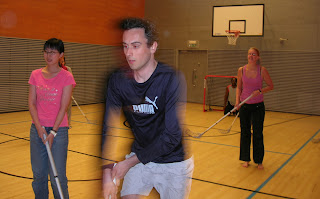
After the dinner, we played floor ball and it was very exciting. We played three matches and last of them was the final match. Esko had explained us the rules of the game. For instance, floor ball is played in a court by five players per side. A floor ball team consist of 4 field players and one goalkeeper. The players should use a stick to put the ball into the other side’s net. And the goalkeeper should keep the ball out of the net. Once we knew the rules, we could start to play. During the match, if someone hit somebody imprudently, he or she would say sorry to him. I think it is very polite. And also, all the team members were very absorbed and united. Everyone cooperated very well, and did their best. Of course, everyone joined the match, even Peter and Jonna. I think the result of the match is not very important, but the process of the match and the teamwork are. That is because at first, some people were very shy; but later, all of us were active. Finally, whether success or failure, everyone was very happy, no one complained, because we had known each others by these matches. The final match was lengthened two times and we lost at the end. We won our first match 1-0 and our second match ended a draw 1-1. Thus we came first in our group and qualified for the final match. In the last match, normal time ended 2-2 and we played two minutes more twice. Although we lost the Final match 4-2, we displayed good example of teamwork. In deed, teamwork is working together cooperatively. Before we met for the first time in the trip, we had not known each other. Owing to the fact that we had determined the area of everybody in the ground before the matches started and everybody tried one’s best in the matches. Teamwork is walking together towards the same goal and helping each other : that is what we did.
These matches helped to know each other at an accelerated speed: starting from our names, as we didn’t know each other before sitting around the same table.


An other example of teamwork, when we cleared the mattresses from the gymnasium on the Saturday morning - some people pilled them up in the corridor and then other people carried them out, it was nearly production-line work.

However, there has been teamwork with the other people since we arrived. Of course, it is easier to go first towards people of the same nationality if one has a problem. But cohesion started to build itself slowly among the international students and that it a other form of teamwork.


picture above : match between teams One and Two – with Liu on the left.

18 septembre 2007

Introduction

As everyone, our story in Finland begins with an introduction...Perfect strangers to each other, we have met and started to build a relationship together.
We are from different parts of the world ...

Liu from China, Helena from France but of Finnish origins, Mehmetali from Turkey and Nicolas also from France.

Different origins, cultures and personalities for one and only scene: Kokkola, for the next few months.

Publicité